What if your next business partner was an algorithm… that actually cared about your carbon footprint?
AI is no longer a shadow productivity boost – it’s quickly becoming a catalyst for entirely new business models. But here’s the inconvenient truth: every prompt has a footprint. The GPU farms powering your “AI magic” pull electricity, consume water for cooling, and generate tons of greenhouse gas emissions.
The challenge – and opportunity – is clear: How do we capture AI’s business potential without releasing an ever increasing amount of GHG?
We’re not just talking “green hosting” here. We’re talking frugal AI: choosing smaller, more efficient models, optimizing workflows to avoid waste, and building products that create net-positive environmental impact. The future winners will be the ones who can turn data into dollars and without additional carbon emissions.
In this article, we’ll explore the shift to AI-driven business models in areas like recruiting, education, and data services. All with a lens on how to design them for both ROI and CO₂ savings.
🔹 The AI Business Model Shift – Now With a Carbon Lens
Traditional business models: make something, sell it, repeat.
AI-driven models: turn patterns into predictions, predictions into products.
But here’s the carbon math: bigger models ≠ better margins if your training and inference costs (and emissions) spiral out of control. The sustainable play is Lean AI (sounds better than Frugal AI). A few high-level strategies include:
- Use domain-specific small models instead of giant general-purpose LLMs.
- Run inference closer to where the data lives to reduce transmission energy.
- Batch processing to avoid idle GPU cycles.
Think of Netflix’s evolution – from shipping DVDs to streaming to predictive content optimization. Now imagine they did it on low-energy inference pipelines paired with renewable energy sources. The business logic stays, the footprint shrinks. Now, let’s looks at some examples.
🔹 Automation in Recruiting – Finding Right Talent with Frugal AI
Recruiting, and by recruiting we mean talent acquisition, candidate sourcing, screening, ATS solutions, etc.; is ripe for AI – but that doesn’t mean running a 175B-parameter model to sort resumes. A few platforms like Hirevue, PyMetrics, and LinkedIn Talent Insights are relying on AI solutions to deliver their value and products. This is a significant jump in productivity from manual resume matching and algorithm based analysis done in the past, much faster too!
While there not much transparency about how their models were built and how many parameters they use, we do know they used pre-existing models and fine tuned them for their business needs. What we do not know, is if these models were optimized for minimal compute or how much energy was used to train them.
What is the opportunity here? AI-powered hiring intelligence as a product that delivers effective skill mapping, predictive retention, and diversity insights while running on sustainable architecture. To follow emerging sustainable technology practices we should consider the following:
- Consider using pre-trained models like JobBERT-v2 or Roberta
- Adopt Green AI Metrics that include emissions per model training as well as inference per candidate matched.
- Use GreenOps practices like batching jobs during low carbon grid times, utilize edge compute as much as possible, and shutdown cloud services where not used.
Carbon-aware recruiting tech doesn’t just save time and money, it makes your platform more attractive to talent who care about sustainability.
🔹 Data Mining & Predictive Analytics using Minimal Parameter Models
Data is the new oil, but refining it doesn’t have to burn the planet.
Companies like Palantir Technologies have built empires on high-powered analytics at a significant cost to our environment. With a more sustainable approach, new ventures can use open-source models fine-tuned on small datasets and adept at data analytics like XGBoost or CatBoost, then use a small text transformer like MobileBERT to translate human input into query parameters. On top of that, here are few more sustainable architecture practices to reduce your carbon footprint:
- All suggestions mentioned earlier in this article still apply!
- Automate insight generation only when data changes significantly.
- Store and process data in green-certified data centers.
The new business model: low-carbon insight-as-a-service. You monetize predictions and sell the story of how you achieved them with 80% fewer emissions than your competitors. In sectors like finance, real estate, and climate tech, that’s a differentiator worth a lot of money.
🔹 AI in Education – Personalized Learning with Minimal Footprint
AI tutors like Squirrel AI and Khanmigo personalize learning at scale. What personalized learning means is that each student runs inference and corresponding energy use, every time they engage with the platform. Scaling doesn’t have to mean spinning up massive compute 24/7.
Imagine LaaS (Learning-as-a-Service) model, that can be efficient and green by adopting some of these tactics:
- Local-first (models run on-device where possible)
- Designed to recycle computation, reusing prior results for similar learners
- Intelligent service orchestration – instead of scaling linearly with number of users, re-use existing compute when students in a region are offline.
This will not only cuts operational costs, it will also reduce the total emissions per student served, resulting in greener solution.
🔹 Emerging Green AI Business Models
In addition to above mentioned business models, here are few more of the fast-growing opportunities at the AI & Sustainability intersection:
- Carbon-Aware AI Digital Agencies – build client solutions that measure and minimize emissions from the ground up.
- Healthcare & Precision Medicine – Hospitals already have high energy footprints. AI used in patient care must minimize compute and energy use to avoid ethical pushback and regulatory concerns.
- Digital Twin Optimizers – AI replicas of experts that simulate low-carbon decisions for industries like logistics or manufacturing.
- FinTech & Investment Platforms – Investors expect sustainable practices. If your AI burns massive amounts of compute to “recommend sustainable stocks,” it’s a contradiction.
- Personalized Consumer Apps – Millions of daily inferences → even small inefficiencies will add up. Green AI ensures costs stay low and branding remains ethical.
Conclusion: Profit + Planet
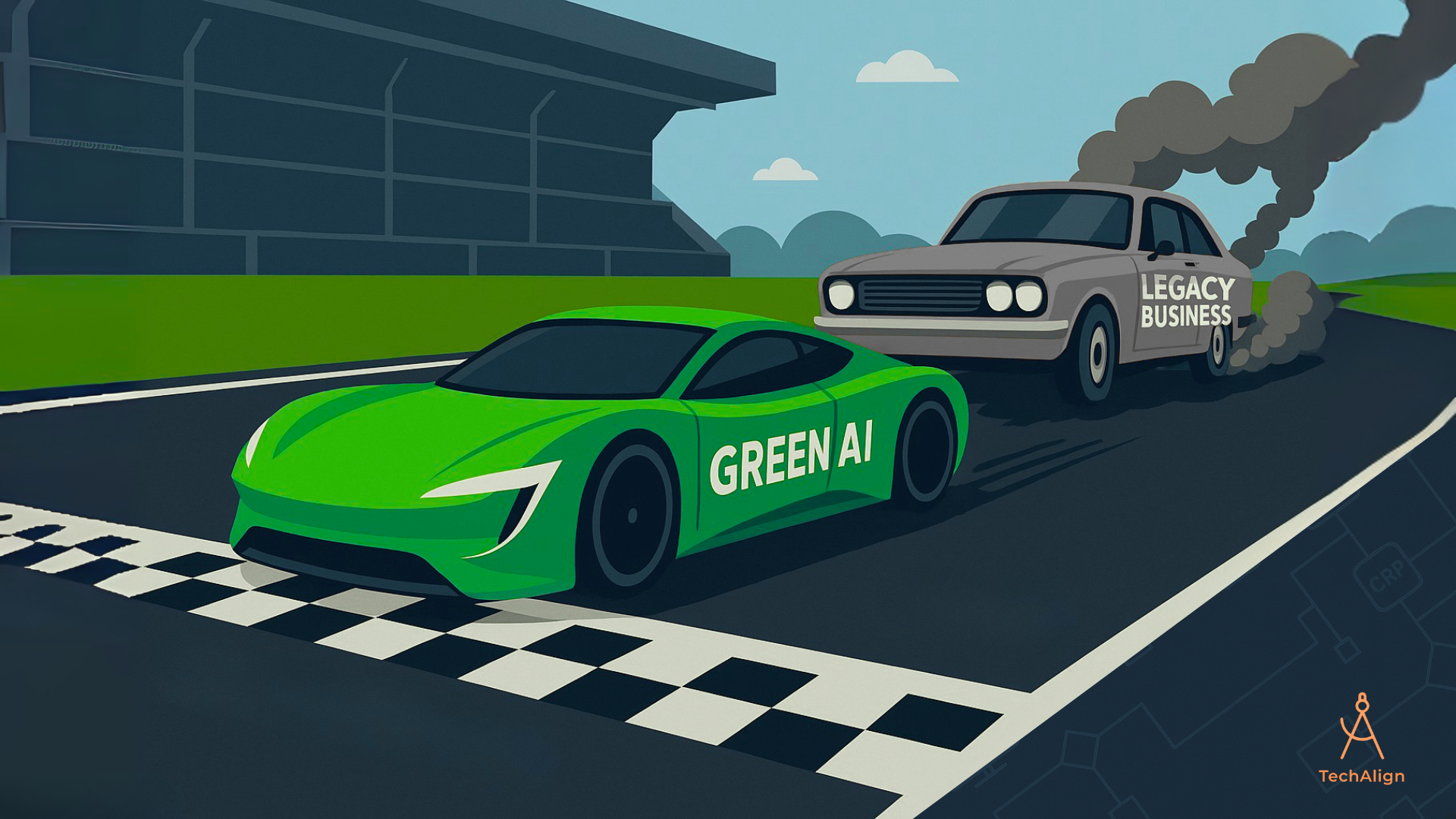
AI can be a huge profit engine or an emissions accelerator – the choice is in the design. The next generation of unicorns will turn lean, sustainable AI into their unfair advantage.
Start lean and green:
- Choose the smallest model that does the job well.
- Run it on the cleanest power you can get.
- Track both financial ROI and carbon ROI.
The next big headline won’t just be about AI making billions – it’ll be about the AI company that made billions while cutting emissions in half.
